
31 March 2026
By Mandla Mpangase
South Africa is entering a new phase in its economic trajectory, with President Cyril Ramaphosa positioning the country as a reform-driven, investment-ready destination focused on inclusive and sustainable growth.
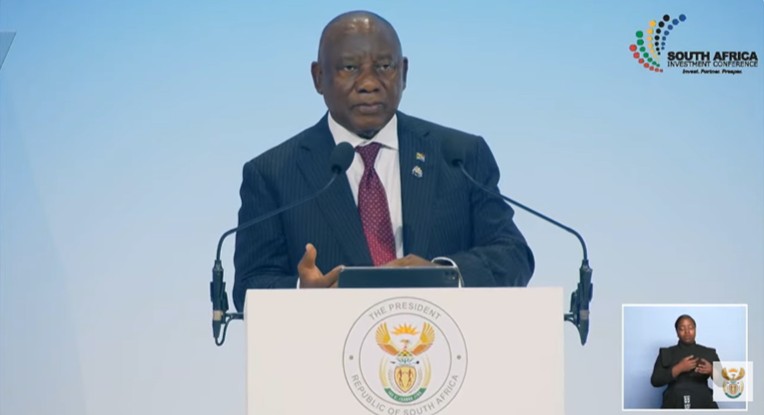
Addressing more than 1 000 delegates from over 50 countries at the sixth South Africa Investment Conference on 31 March 2026, Ramaphosa made it clear that the government’s priority is not only to attract capital, but to ensure investment translates into tangible, broad-based benefits.
“We are creating the conditions for investment-led growth that is broad-based, inclusive, and durable,” he said.
“Investment conferences such as this are an opportunity for us to showcase the attractiveness of investment opportunities in our country to domestic and international investors. By connecting investors with local opportunities, we are able to attract foreign direct investment (FDI). They also facilitate strong partnerships by bringing together governments, business, banks, and development finance institutions.”
Gauteng, the country’s economic hub, provided a fitting backdrop. As the largest contributor to national GDP, the province remains central to South Africa’s investment proposition.
South Africa’s post-1994 journey has been marked by resilience. The country has navigated global and domestic shocks, from the financial crisis to state capture and the COVID-19 pandemic, while maintaining institutional stability.
Now, that resilience is being translated into growth. Under the Government of National Unity formed after the 2024 elections, the economy has recorded four consecutive quarters of expansion into early 2026, alongside stabilising inflation and improved investor sentiment.
However, Ramaphosa stressed that credibility must be backed by delivery.
“We know that investors reward execution, not just commitment,” he said, highlighting a shift toward measurable reform outcomes.
Central to this effort is Operation Vulindlela, a joint initiative between the Presidency and National Treasury aimed at removing structural constraints to growth. Its focus is on reducing the cost and complexity of doing business across key sectors, including energy, logistics, water, and visas.
Nowhere has reform been more consequential than in the energy sector. Following years of load shedding, the government has restructured the electricity market, unbundled Eskom, and opened the grid to private investment. The result is a rapidly expanding pipeline of renewable energy projects and improved energy security.
Through these interventions, Ramaphosa said, “we have brought an end to load shedding and ensured a reliable supply of electricity”, a critical milestone for restoring investor confidence.
Energy reform also underpins South Africa’s broader transition to a low-carbon economy. Opportunities in green hydrogen, electric vehicle manufacturing, battery storage, and critical minerals are expected to drive future growth, while aligning with global climate commitments. With its significant reserves of platinum group metals and other resources, the country is well-positioned to play a strategic role in global clean energy value chains.
Importantly, the transition is being framed as inclusive. “We have been firm that the energy transition must be just and that it should leave no one behind,” Ramaphosa said.
Infrastructure investment is another cornerstone of the growth strategy. Over the next three years, the government has committed more than R1 trillion to infrastructure development across transport, energy, water, and digital systems.
“Infrastructure is the flywheel that propels growth,” Ramaphosa said, noting its role in reducing costs, improving productivity, and creating jobs at scale.
The approach is designed to crowd in private sector participation. Reforms in logistics are opening rail and port operations to competition, while new public-private partnership frameworks and blended finance instruments aim to de-risk investment and accelerate delivery. In the water sector, a pipeline of projects worth more than R50 billion is being prepared for private investment.
Beyond infrastructure, the government is emphasising inclusion. Investment projects are expected to incorporate local content, skills development, and community benefits, ensuring that growth is shared more widely.
At the same time, South Africa’s empowerment framework is being refined to balance transformation with investment attraction. Mechanisms such as the Equity Equivalent Investment Programme allow multinational firms to contribute to development without altering ownership structures.
“Our overriding objective is to support firms with compliance, and to embrace empowerment as a meaningful investment in South Africa’s long-term economic stability,” Ramaphosa said.
The conference also marked the launch of a second investment mobilisation drive, targeting R2-trillion in new investments between 2026 and 2030. This builds on the success of the first drive, which exceeded its R1-trillion target.
The new phase begins with a strong pipeline of 81 projects worth nearly R890-billion, expected to create more than 230 000 jobs.
“This is not ambition for its own sake,” Ramaphosa said. “It is the arithmetic of what South Africa requires to achieve meaningful unemployment reduction and industrialise at scale.”
As global uncertainty reshapes capital flows, South Africa is positioning itself as a stable, reform-oriented destination. While Africa continues to attract a relatively small share of global foreign direct investment, the country remains a leading recipient on the continent.
“We are meeting at a time of uncertainty for the global economy. Geopolitical fragmentation, supply chain disruptions from conflicts and wars, and trade tensions are radically impacting global capital flows,” Ramaphosa noted.
“In such conditions, South Africa presents a favourable proposition as a resilient, credible and reform-oriented investment destination with strong fundamentals.”
Ultimately, the success of this strategy will depend on sustained implementation.
“This is only the start of an era of new growth and dynamism for South Africa’s economy,” Ramaphosa said.
The task now is to convert investment commitments into real projects and ensure those projects deliver lasting, inclusive growth.