
9 April 2026
By Mandla Mpangase
South African Deputy President Paul Mashatile has positioned Gauteng as the critical engine for converting South Africa’s record investment pledges into tangible economic outcomes, urging faster implementation, stronger partnerships, and a renewed focus on industrialisation.
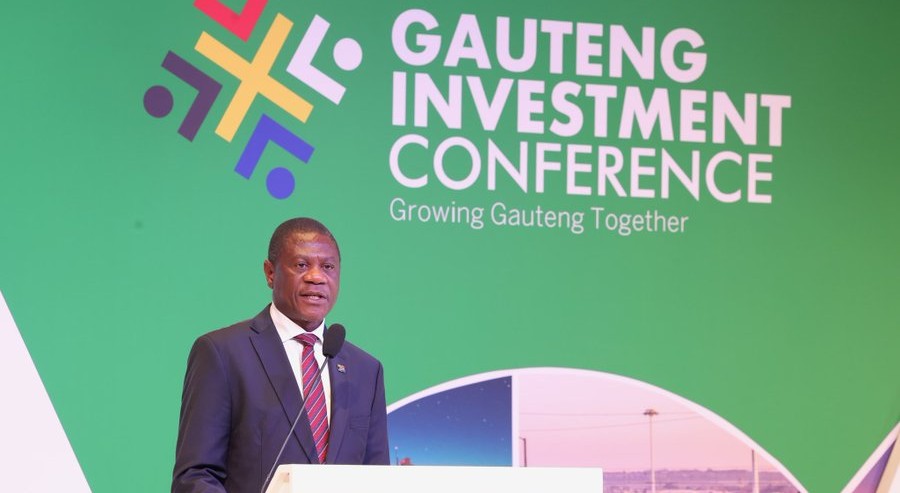
Addressing the 2026 Gauteng Investment Conference on Thursday, 9 April 2026, Mashatile said the province would play a central role in delivering on the commitments secured at the recent South African Investment Conference 2026, where approximately R890-billion in pledges were announced in a single day.
The latest commitments push total investment pledges since 2018 to well over R1.5-trillion, prompting the government to set a new national target of R3-trillion in the years ahead.
From pledges to implementation
Mashatile stressed that the credibility of South Africa’s investment drive would depend not on headline figures, but on execution.
“The true value lies in delivery – translating commitments into factories, infrastructure, energy capacity, and above all, jobs,” he said.
In this context, Gauteng, South Africa’s largest contributor to GDP and a gateway to regional and global markets, has been identified as the primary platform where many of these projects will be implemented and scaled.
The Gauteng Investment Conference, he noted, serves to “localise investment, accelerate execution, and remove obstacles at project level”, effectively bridging the gap between national ambition and on-the-ground delivery.
Aligning national priorities with provincial strengths
Mashatile said many of the investments announced at the South African Investment Conference align directly with Gauteng’s economic strengths, including advanced manufacturing, energy, logistics, digital services, and infrastructure development.
The province’s industrial base, financial system, skilled workforce, and connectivity position it as a natural hub for large-scale project rollout.
“This conference moves us from national pledges to provincial pipelines, from policy certainty to site readiness, and from investor intent to operational delivery,” he said.
A new model of industrialisation
Framed under the theme Re-industrialising Africa’s Gateway, Mashatile outlined a modern approach to industrialisation built on four pillars:
- Infrastructure as a foundation: Reliable energy supply, efficient logistics, water security, and digital infrastructure are essential to enabling industrial growth. Government, he said, is prioritising investment in energy stability, rail and port efficiency, and bulk infrastructure.
- Digital transformation: The Deputy President highlighted the growing importance of data centres, artificial intelligence, fintech and cloud infrastructure, describing them as the “backbone of modern economies.” Gauteng, he added, is well placed to lead in digital industry development.
- Regional integration through AfCFTA: Mashatile pointed to the African Continental Free Trade Area as a key mechanism for building regional value chains and boosting intra-African trade. Gauteng is positioning itself as a continental execution hub where trade agreements are translated into real economic activity, Mashatile said.
- Inclusive growth: Industrialisation must expand opportunities for young people, township economies and small businesses, ensuring that growth is broad-based and socially impactful.
Investment lifecycle approach
Mashatile said the Gauteng Investment Conference is evolving into a full investment lifecycle platform, covering project origination, preparation, financing, implementation, and delivery.
Government’s role, he said, is to de-risk investment through policy certainty and regulatory efficiency, crowd in private capital, and ensure accountability through project tracking and coordination across all spheres.
“Credibility is built not on what we announce, but on what we deliver,” he said.
Call for public-private partnership
The deputy president called for deeper collaboration between government, business, and development finance institutions to unlock large-scale investment.
He urged businesses to invest in skills development, support localisation and integrate small enterprises into value chains, while positioning themselves as “co-architects” of South Africa’s industrial future.
Investors, meanwhile, were encouraged to view South Africa, and Africa more broadly, not as a risk, but as a long-term growth opportunity.
“Africa is not a risk story; it is a growth and return story,” Mashatile said.
Gauteng as a gateway to Africa
Reaffirming Gauteng’s strategic importance, Mashatile said the province offers a combination of returns and resilience, underpinned by a skilled workforce, established infrastructure, and a commitment to enterprise development.
He concluded with a call to action for all stakeholders to move decisively from commitments to implementation.
“Let this conference mark a turning point, from commitments to implementation, towards integrated growth that is inclusive, sustainable, and transformative,” he said.