
17 July 2026
By Mandla Mpangase
Deputy President Paul Mashatile has unveiled an ambitious 20-year strategy to transform South Africa’s Special Economic Zones (SEZs) into globally competitive industrial hubs, warning that underperforming zones could lose their designation if they fail to deliver jobs, investment, and exports.
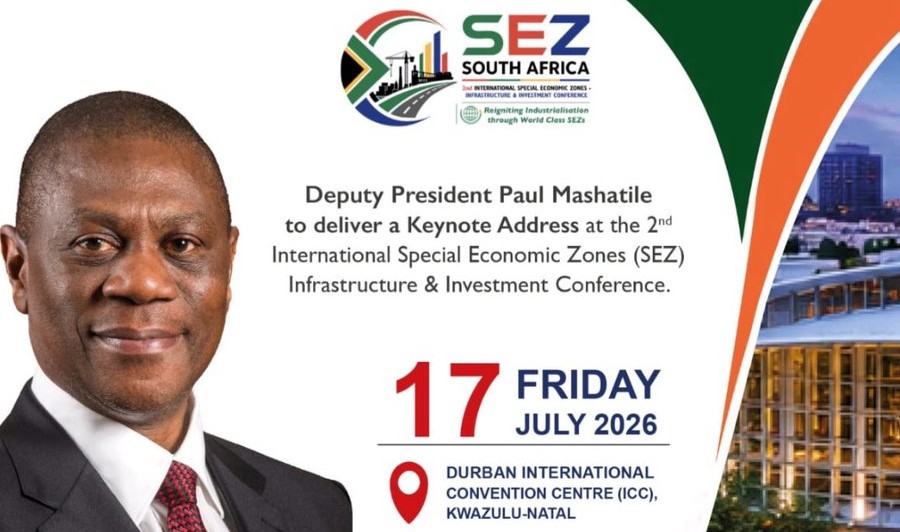
Delivering the keynote address at the second International Special Economic Zones Infrastructure and Investment Conference at the Durban International Convention Centre on Friday, 17 July 2026, Mashatile said South Africa had entered a “third phase” of industrial development, with SEZs positioned at the centre of the country’s manufacturing-led growth agenda.
The conference, attended by government leaders, investors, industry executives, and international partners, focused on the role of SEZs in reigniting industrialisation and positioning South Africa as a competitive investment destination.
Mashatile said South Africa’s industrial policy had evolved from the Industrial Development Zone programme introduced in 1997 to the current SEZ model, which is now being strengthened through a new Spatial Industrial Development Strategy.
“We are not planning for the next election cycle. We are planning for the next generation,” he said.
Central to the strategy is a 20-year development framework approved by Cabinet that will subject every SEZ to formal performance evaluations every five years.
The first phase will focus on auditing every zone and establishing measurable performance indicators covering investment attracted, jobs created, exports, and linkages with small businesses.
Zones that fail to achieve at least 60% of these targets after five years will face intervention, restructuring, repurposing or even de-designation.
Mashatile said future success would depend on reliable infrastructure, effective governance and stronger integration between SEZs, municipalities and surrounding communities.
“No zone can thrive in isolation,” he said, outlining six criteria that will guide future industrial development, including infrastructure corridors, natural resource advantages, industrial parks, district economic planning, socio-economic needs and community integration.
The deputy president said South Africa’s SEZ programme had already demonstrated its value.
Referring to a World Bank assessment, Mashatile said the programme had attracted R14.8-billion in revenue while creating more than 30 000 jobs across industries, including automotive manufacturing, agro-processing, and renewable energy.
He singled out the Tshwane Automotive Special Economic Zone (TASEZ) and the Coega Industrial Development Zone as examples of successful industrial platforms that have strengthened skills development and local supply chains.
However, he acknowledged that lessons had been learnt from earlier industrial zones, where some investment represented companies relocating rather than establishing new operations.
Government’s renewed approach, he said, aims to ensure that SEZs stimulate genuine economic growth while delivering benefits to surrounding communities rather than functioning as isolated industrial enclaves.
Mashatile said the new industrial strategy is built around three priorities: decarbonisation through low-carbon industries, diversification of manufacturing into higher-value exports, and digitalisation to improve productivity across the economy.
The ultimate objective is to raise manufacturing’s contribution to South Africa’s gross domestic product from its current level of about 12%, while addressing unemployment, particularly among young people and women.
The deputy president also highlighted the incentives available to investors operating in qualifying SEZs, including a preferential 15% corporate tax rate, manufacturing tax allowances, VAT and customs relief, and employment incentives for youth.
Provincial development agencies would continue to provide serviced industrial land, infrastructure, and skills programmes, while municipalities would be expected to accelerate planning approvals and increase procurement opportunities for local small businesses.
“Incentives are not entitlements,” Mashatile cautioned. “They are part of a compact. In return, we expect investment, exports, jobs and transformation.”
Despite the incentive package, Mashatile acknowledged that South Africa faces intense international competition.
With more than 5 400 SEZs operating globally, he said the country could not rely on low costs alone to attract investment.
“We compete by being the most strategic, the most reliable, and the most inclusive.”
He urged SEZ executives, municipal leaders and investors to work together to improve infrastructure, expand industrial clusters and deepen local supplier participation.
Addressing investors directly, Mashatile said South Africa remained open for business but expected investment to contribute meaningfully to local development.
“We are not open for extraction. We want you to benefit here, to train here, and to partner with our small, medium, and micro enterprises (SMMEs) here.”
In closing, Mashatile called for renewed commitment to ensuring that SEZs become catalysts for inclusive economic growth across all provinces.
“Our SEZs must become engines of investment, innovation, and opportunity, not islands of prosperity, but catalysts for inclusive growth that will uplift every province and every community across our country.”