
Tshwane councillors encouraged by TASEZ progress after oversight visit
15 May 2026
Tshwane councillors have expressed confidence in the progress made at the Tshwane Automotive Special Economic Zone (TASEZ), saying the project is emerging as one of the City’s most important industrial development platform, writes Mandla Mpangase.
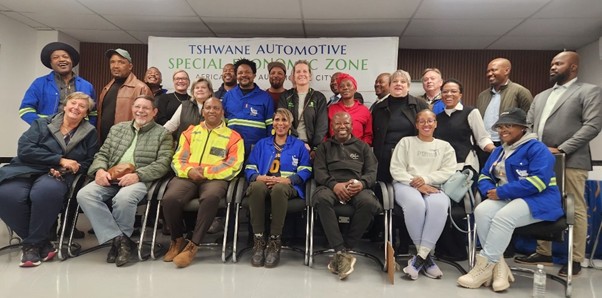
Members of the City of Tshwane’s Section 79 Oversight Committee on Integrated Development Planning, visited TASEZ on 12 May 2026 for an oversight inspection and engagement with management. The visit included a presentation by the TASEZ leadership team and a walkabout of two facilities within the Special Economic Zone (SEZ).
The engagement focused on job creation, small, medium and micro enterprise (SMME) development, infrastructure delivery and the zone’s next phase of expansion, which is expected to deepen Tshwane’s position as one of South Africa’s automotive manufacturing hubs.
TASEZ CEO Dr Bheka Zulu briefed councillors on the SEZ’s development, performance and strategic positioning as one of Gauteng’s most significant industrial projects, anchored by Ford’s Silverton operations and positioned in the wider Tshwane automotive corridor.
Zulu said Tshwane produced about 40% of South Africa’s passenger vehicles and was home to five original equipment manufacturers – Ford, BMW, Nissan, Iveco and UD Trucks – with Chery also expected to enter the market. The region also hosts more than 100 component suppliers and supports more than 40 000 direct jobs in the automotive sector.
Since its establishment, TASEZ in its first phase of development has attracted R4.12-billion in government investment and R5.9-billion in private-sector investment. It has created 5 500 construction jobs and 3 422 permanent jobs, while more than R1.7-billion has been spent on SMME procurement.
The first phase of the project was largely built around supplier facilities linked to Ford’s R16-billion investment in its Silverton production plan in South Africa between 2020 and 2023, followed by a further R5.2-billion investment cycle from 2024 to 2026. Zulu said the zone’s supply-chain impact extended to about 10 000 jobs and made a significant contribution to GDP.
He also highlighted TASEZ’s transformation and enterprise-development work. TASEZ reported that 229 SMMEs had benefited from Phase 1 and Phase 1A, while 265 SMME packages had been awarded and 370 SMMEs trained.
TASEZ infrastructure executive Andile Sangweni briefed councillors on the SEZ’s expansion plans, saying the master plan included the 81ha Phase 1, a 10.5ha Phase 1A, an 81ha for Phase 2, and future land parcels.
Phase 2 includes an industrial node, the TASEZ Centre of Excellence campus, truck staging and mixed-use elements aligned with market demand.
Sangweni said Phase 2 was already being implemented, with work under way on the La Montagne reservoir, bulk water reticulation, bulk electrical infrastructure, roads, stormwater systems and internal engineering services.
TASEZ expects Phase 2 to unlock further economic activity, with government investment of R1.95-billion in top structures and bulk services, and private-sector investment of R3.5-billion in machinery, equipment and technology. The phase is expected to create 2 000 construction jobs and 2 500 permanent jobs.
The zone is also looking increased SMME procurement, with a minimum 30% of spending earmarked for SMME participation.
The visit came as TASEZ advances plans to diversify its energy infrastructure. Sangweni said the zone’s energy plans include a solar independent power producer project by Heshun, which is expected to install rooftop solar photovoltaic and battery storage systems across selected factories in Phase 1 and Phase 1A.
The project is expected to provide 20MW of photovoltaic capacity with battery storage, carry an estimated investment value of R600-million and be completed by May 2027. The solar project forms part of TASEZ’s broader green energy initiatives and extends its energy mix programme, which also includes a 20MVA gas-to-power solution.
Zulu said the visit was more than a routine site inspection.
“For Tshwane, the visit was more than a routine site inspection. TASEZ is an implementation partner of the City, has been in operation for five years and is linked to a memorandum of understanding with the municipality,” he said.
“The engagement gave councillors an opportunity to see first-hand the progress being made, the economic impact already delivered, and the next phase of work required to deepen Tshwane’s role in South Africa’s automotive economy.”