Tasez

Thought leaders

The green shoots of an economic recovery

In his weekly newsletter published on 17 November 2025, President Cyril Ramaphosa wrote that in the week of the G20 Leaders’ Summit – the first to be held on African soil – South Africa is able to showcase a country and an economy on the rise. In the week that we prepare to host the first summit of the G20 on African soil, we are able to showcase a country and an economy on the rise. A number of key economic indicators and developments in the past week point to the green shoots of an emerging economic recovery. Unemployment is down. Data from Statistics South Africa show that the official unemployment rate fell to 31.9% between July and September this year, down from 33.2% recorded in the previous quarter. Nearly 250 000 more people were in employment in the third quarter. Of these, around 130 000 were added in the construction sector. The Medium-term Budget Policy Statement delivered last week points to a sustained turnaround in government finances. We are on track to achieve a third consecutive primary budget surplus. This means that, excluding interest payments on our debt, we are collecting more in revenue than we are spending. This is a sign of prudent financial management, giving us space to steadily reduce our debt to sustainable levels. Also last week, our sovereign credit rating was upgraded by S&P. This is the first such upgrade from the agency in nearly two decades. An improved rating generally leads to lower borrowing costs, which allows for more funds to be invested in the economy and in meeting social needs. Among the factors S&P cited for the positive outlook were Eskom’s improved performance, strong tax collection, and the broad structural reform momentum having ‘picked up pace’. When we established Operation Vulindlela in 2020 as a government coordinating mechanism to implement transformative reforms and boost economic growth, the initial focus was on the network sectors as well as immigration reform. We are seeing steady progress in the logistics sector, notably with respect to improved performance at our ports. Measures to allow private sector companies to operate on the national freight rail network are also at an advanced stage. The most noteworthy improvements have been witnessed in the energy sector, with Eskom now on the road to recovery, massive investment in renewable energy generation, and vastly improved electricity supply. In support of South Africa’s ratings upgrade, S&P cited the recently launched Phase II of Operation Vulindlela, which is focusing on changes in local government, digital transformation, visa regimes, spatial inequality and others. Modelling from the University of Stellenbosch’s Bureau of Economic Research (BER) has estimated that the potential impact of the Operation Vulindlela reforms could lift South Africa’s long-term growth rate by as much as 3.5% when fully implemented. In citing this modelling, the analyst JP Landman writes that “the reforms are a journey, but they have started working. Step by step, South Africa is opening its economy, modernising infrastructure and rebuilding credibility”. Despite considerable headwinds that have included a global pandemic, a debilitating energy crisis and more recently, a difficult global trade environment, we have stayed the course on economic recovery and are now seeing this pay off. Following a ruinous period of economic stagnation and capture of the state, we have been able to achieve sustained progress in a relatively short period of time. This is in no small part owing to the strength of the partnerships forged between government, business, labour and civil society. These far-reaching economic changes have a direct and material impact on the lives of every South African, on their ability to lead dignified lives, to access public services, to secure employment, and to provide for their families. We are determined to sustain the momentum of this economic recovery, so that we can drive inclusive growth, create jobs and improve the lives of our citizens.

BBBEE can help drive industrial transformation in SA’s automotive sector

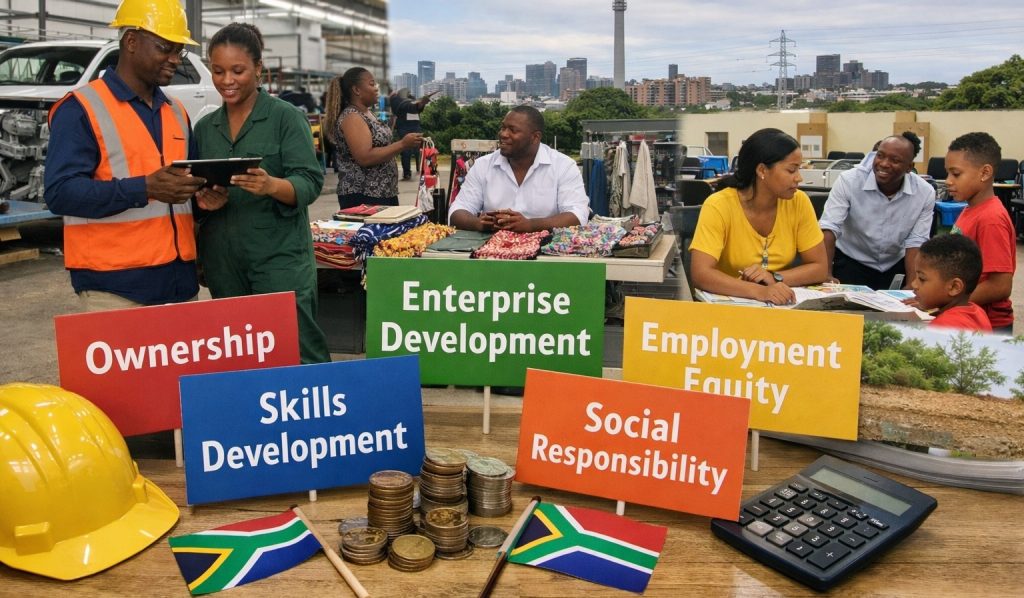
Broad-based black economic empowerment was never meant to be about compliance. It was meant to be about change, about opening doors, building skills, and creating real economic inclusion, writes Dr Bheka Zulu, CEO of the Tshwane Automotive Special Economic Zone. When we talk about transformation in South Africa’s economy, it often sounds like we are talking about paperwork. Too often, broad-based black economic empowerment (BBBEE) gets treated as a box-ticking exercise, a scorecard to be managed, instead of a movement to be led. But BBBEE was never meant to be about compliance. It was meant to be about change, about opening doors, building skills, and creating real economic inclusion. At the Tshwane Automotive Special Economic Zone (TASEZ), we sit at the crossroads of two of South Africa’s biggest goals: industrialisation and empowerment. This week, as we hosted a BBBEE Commission workshop with our tenants, partners, and local community representatives, one issue came into clear focus – transformation in the automotive sector must go beyond talk. It needs to deliver real, measurable results. A sector that matters The automotive industry plays a huge role in South Africa’s economy. It contributes around 5.3% to the national GDP and about 30% of the total manufacturing output. Behind those numbers are people – more than 130 000 direct jobs, and many thousands more through the supply chain. But the truth is, transformation has not kept pace with this growth. Leadership in the sector still does not reflect the demographics of our country. Ownership remains concentrated. Supplier development often stops at token efforts. As the industry shifts toward new energy vehicles (NEVs), we have an opportunity to correct this. The future of the automotive sector cannot mirror the inequalities of the past. BBBEE gives us the framework to do things differently. The codes of good practice were never just about ownership; they were about five interconnected pillars: ownership, management control, skills development, enterprise and supplier development, and socio-economic impact. These must now become the foundation for how we build a fairer, more innovative, and future-ready industry. Turning policy into progress At TASEZ, we have made a deliberate choice to make transformation practical and measurable. In recent years, we have channelled more than R1.7-billion in contracts to small, medium and micro enterprises (SMMEs), many of them black- and women-owned. Over 40% of our procurement is local. Those are not just numbers on a page; they translate to more than 5 000 jobs created during construction, 80% of them for women and 60% for young people. People with disabilities are also increasingly part of our projects. But transformation is not just about procurement spend. It is about building capacity that lasts. I would suggest we establish a Skills Development Forum that brings together original equipment manufacturers (OEMs), component suppliers, and local colleges to ensure the skills we teach match the jobs that exist and those that will exist in the future. Small businesses are another priority. Many promising enterprises do not fail because of a lack of ideas; they fail because they do not have the support systems for compliance, HR, or financial management. That is why TASEZ is introducing shared back-office support for SMMEs in the automotive value chain. If we want black industrialists to thrive, we cannot expect them to do it alone from garages and backrooms. Building local capacity Real transformation is also about building economic independence. For too long, our sector has depended on imports. We have to change that by focusing on localisation and innovation. Our goal, as expressed in the South African Automotive Masterplan 2035, is to raise local content levels from 40% to at least 60%. That means developing black-owned suppliers into full manufacturers, innovators, and exporters, not just intermediaries. It means investing in partnerships with universities and research institutions, so that South African engineers and entrepreneurs can lead the way in electric mobility, battery recycling, and green manufacturing. We should also establish a Green SMME Innovation Sandbox to support enterprises involved in circular-economy opportunities such as waste recovery, e-waste, and battery recycling. Let us create a space where new ideas can be tested. The future of BBBEE is as much about sustainability as it is about ownership. Inclusion must be intentional True transformation leaves no one behind. We have seen the incredible results when women and people with disabilities are intentionally included in training, production, and leadership. That inclusion needs to become standard practice. The same applies to our local communities. Our social compact with residents around TASEZ is not symbolic, it is real. Through enterprise incubation, community training, and mentorship programmes, we are working to make sure that the special economic zone (SEZ) model uplifts the people who live closest to it. Transformation and competitiveness go hand in hand The automotive sector is at a major turning point. By 2035, the world will be dominated by NEVs. Export markets are already tightening their emissions standards, and if we don’t adapt quickly, we risk being left behind. Transformation must therefore be seen as a tool for competitiveness. BBBEE should drive innovation and productivity, not just compliance. It should open doors for local firms to access global supply chains and strengthen their ability to compete. That means better financing for black suppliers, guaranteed offtake agreements, and strong mentorship partnerships between international OEMs and emerging South African manufacturers. The road ahead Our message is simple: let us reclaim BBBEE as a national mission for industrial renewal. Let us link empowerment to productivity, localisation to sustainability, and inclusion to innovation. The next phase of transformation must be about building black-owned exporters, green manufacturers, and a generation of young technicians ready for the digital and green mobility era. We need to move from counting scorecards to building real capacity, because transformation is not only about fairness, it is about South Africa’s readiness for the future.

Gauteng takes the wheel: Driving Africa’s NEV future

South Africa’s shift to green mobility is no longer a distant idea, it is now a commercial necessity, and the economic heartland of the country must take the lead in embracing New Energy Vehicles as a core economic sector for the country – and the rest of Africa, writes Lebogang Maile, Gauteng MEC for Finance and Economic Development. Gauteng is stepping up to lead South Africa and Africa into the new-energy vehicle (NEV) era. The province, already the country’s economic and industrial centre, is positioning itself as the continent’s NEV hub. The province hosted its inaugural NEV Summit on 22–23 October 2025, during the country’s Transport Month, under the auspices of the Gauteng Growth and Development Agency, along with the Automotive Industry Development Centre (AIDC) and the Tshwane Automotive Special Economic Zone (TASEZ). South Africa’s shift to green mobility is no longer a distant idea, it is now a commercial necessity. Gauteng is determined to lead South Africa’s transition to electric and low-carbon mobility. The South African automotive industry is facing a tough operating environment, heightened by the imposition of a unilateral 30% reciprocal trade tariff by the government of the United States, which has consistently been South Africa’s second-largest trading partner and key export destination for South African-manufactured vehicles. The sector is particularly vulnerable to the 25% sectoral tariff imposed under Section 232 of the United States Trade Expansion Act of 1962, which specifically targets automotive exports. In addition, global markets, particularly the European Union, are tightening carbon regulations. For South Africa to keep exporting vehicles and stay competitive, it must move fast to build an industry that produces low- and zero-emission cars. Laying the foundation The transition is backed by strong policy frameworks. The South African Automotive Master Plan 2035 (SAAM 2035) sets clear goals for increasing local content, boosting exports, and creating inclusive growth. The government’s White Paper on electric vehicles, approved at the end of 2023, provides a roadmap for building the NEV ecosystem from production and charging infrastructure to skills development and consumer incentives. Although the paper references electric vehicles, South Africa must take into account other green initiatives, such as hydrogen and battery. The policy direction is clear – our job is to make sure Gauteng becomes the first mover. The NEV transition is about jobs, skills, and industrialisation, not just greener cars. We are ready to lead Africa in this journey. Why Gauteng? South Africa’s economic hub has all the right ingredients: skilled workers, advanced manufacturing infrastructure, financial and logistics networks, and a strong automotive heritage. Ford, based in the City of Tshwane, has been in South Africa for over a century. Gauteng’s existing automotive value chain makes it the natural home for Africa’s NEV future. The province already hosts major original equipment manufacturers like BMW, Ford, and Nissan, and supplier networks that can pivot to battery, electronics, and component manufacturing. We already have the backbone, from vehicle assemblers to tiered suppliers. What we are doing now is aligning that value chain with new technologies, from battery assembly to software integration. The transition is not just about attracting investment; it’s about future-proofing Gauteng’s manufacturing economy. Turning policy into factories Gauteng is now focused on turning national policy into tangible projects. The Automotive Investment Scheme (AIS) and EV production incentives announced by the Department of Trade, Industry and Competition (the dtic), including a 150% investment allowance for qualifying projects, are key tools to make that happen. We are working closely with the dtic and industry stakeholders to streamline approvals and remove red tape. Investors do not want promises; they want certainty. Gauteng is offering that – a clear pathway from policy to plant. But we are also well aware of the challenges we face, from electricity reliability and logistics to the high costs of new technologies. One of the key projects we have put in place to overcome these is the creation of a dedicated automotive hub in the City of Tshwane, with stable power, fast-tracked permitting, and shared testing and recycling facilities to lower entry barriers for manufacturers. Building demand and inclusion A vibrant NEV industry also needs a domestic market, and Gauteng is exploring ways to stimulate demand through public fleet electrification, taxi modernisation programmes, and municipal procurement. Demand creation will be critical to attracting more investors. OEMs and suppliers want to see that South Africa is serious about NEVs – that there is a real market for these vehicles. If we in government lead by example through fleet conversion, others will follow. Gauteng has the opportunity to set that example for the rest of the continent. Beyond manufacturing, Gauteng’s NEV strategy emphasises skills development and inclusion. The transition is being designed to create opportunities for black-owned medium, small, and micro enterprises, youth, and women entrepreneurs in new parts of the value chain, from charging infrastructure to digital mobility services. A turning point for the economy The upcoming NEV Summit is expected to produce a clear action plan: identifying priority sites, announcing anchor investors, setting timelines for disbursing incentives, and mapping out power and logistics upgrades. This summit was not just about speeches; it was about signatures. We want commitments, timelines, and projects that will create jobs and secure Gauteng’s place at the centre of Africa’s new energy future. If Gauteng can convert its strategic intent into action, the province will not only revitalise South Africa’s automotive manufacturing base but also anchor the continent’s NEV revolution. The race to lead Africa’s green mobility future has begun, and Gauteng plans to be first across the line.

From policy to action: Now is the time for South Africa to embrace new energy vehicles

South Africa must move from policy to action as a matter of urgency, aligning incentives, infrastructure, skills, and industrial coordination around new energy vehicles, writes the CEO of Tshwane Automotive Special Economic Zone, Dr Bheka Zulu. South Africa’s automotive industry stands at a turning point. The global race toward low- and zero-emission mobility is accelerating, and for a country whose automotive exports hinge on access to the European market, embracing new energy vehicles (NEVs) is no longer optional, it has become an industrial necessity. The Electric Vehicle (EV) White Paper and the South African Automotive Master Plan 2035 (SAAM) together lay a strong policy and strategic foundation. The challenge now is moving from intent to implementation. The country has a clear opportunity to build an inclusive, competitive, and sustainable automotive industry powered by innovation, ready for a net-zero world. Transformation is a must The global automotive landscape is undergoing a profound transformation, driven by the urgency to reduce carbon emissions and achieve net-zero goals. The European Union’s carbon neutrality policies are among the most influential in this shift, setting strict timelines for phasing out internal combustion engine (ICE) vehicles and promoting zero- and low emission alternatives. The EU aims to be climate-neutral by 2050. The objective is to ensure an economy with net-zero greenhouse emissions. For South Africa, this presents both a challenge and an opportunity. The EU remains South Africa’s largest export market for vehicles, accounting for the bulk of automotive exports. A significant 68,7% of light vehicle production was exported in 2024, with three out of every four cars headed to Europe. This means that the EU’s green regulations will directly determine South Africa’s ability to continue trading competitively in this critical sector. Vehicles built in Gauteng and other parts of the country will increasingly need to meet low- or zero-emission standards to remain eligible for export. Transitioning now is not optional, it is essential. Early investment in NEV production, local battery manufacturing, and supporting infrastructure such as charging networks will safeguard South Africa’s market access, maintain its global competitiveness, and create a foundation for long-term industrial sustainability. Policy meets opportunity The EV White Paper charts a managed transition from internal combustion engines to cleaner technologies, ensuring decarbonisation does not lead to deindustrialisation. It sets out steps to localise EV production, develop charging infrastructure, and build skills for the future. The White Paper allows for a managed transition, setting out a number of processes: It has identified 10 actions required to build an EV production ecosystem, including the beneficiation of critical minerals, battery reuse and refurbishment, regulatory alignment, and incentives for localisation. Complementing it, the South African Automotive Master Plan (SAAM 2035) envisions South Africa increasing local content in vehicle manufacturing, expanding exports, and doubling employment by 2035. SAAM 2035 sets out six focus areas: optimising the local market, developing the regional market, localisation, infrastructure development, industry transformation, and technology a skills development. Targets include: Together, the EV White Paper and SAAM 2035 frame a just, inclusive transition that can preserve and grow the country’s industrial base. Driving implementation Turning these policies into tangible outcomes depends on strong institutions. In Gauteng, the Gauteng Growth and Development Agency (GGDA), its subsidiary the Automotive Industry Development Centre (AIDC), and the Tshwane Automotive Special Economic Zone (TASEZ) are taking the lead. TASEZ, Africa’s first automotive city, is positioning itself as a hub for future-focused investment, where manufacturers and suppliers can plug into purpose-built infrastructure, training, and incentives. The AIDC, through its learning centres and supplier parks, is aligning skills and enterprise development with EV technologies. Together, these institutions are turning national ambition into provincial action. South Africa must act quickly to overcome power constraints, develop a local battery value chain, and align incentives to attract NEV and component investment. Global markets are already shifting and delays could cost South Africa export access, investor confidence, and thousands of jobs. A call to lead Africa’s NEV revolution The upcoming 2025 NEV Summit, hosted by GGDA, AIDC, and TASEZ on 22-23 October 2025 at the Gallagher Convention Centre, represents the next phase: uniting government, industry, and investors to accelerate implementation. From policy to action, South Africa’s NEV future depends on decisive execution.

Collaboration is needed to gear up to new auto future

If South Africa is to transform the automotive sector as spelt out in the South African Automotive Master Plan 2035, the industry must take decisive action on a wide range of issues, including decarbonisation, writes TASEZ CEO Dr Bheka Zulu. As the country’s special economic zone (SEZ) focused primarily on the automotive industry, the Tshwane Automotive Special Economic Zone (TASEZ) is ready to play a key role in moving the transformation efforts forward. While South Africa has set itself the task of zero net emissions by 2050, many of the country’s automotive export markets have set stringent targets over the next decade and the original equipment manufacturers (OEMs) are gearing up for the change. No doubt, this will be one of the main talking points at this year’s South African Auto Week, taking place in Cape Town from 15 – 18 October 2024. The theme for this year’s event is Reimagining the Future Together: Celebrating 100-Years of automotive heritage, passion, resilience and ingenuity. Among the topics up for discussion are “Decarbonising the auto sector”, “A path to net zero”, and “SA NEV (new energy vehicle) transition: Policy choices and support instruments”. It is against these current discussions that input from research by Deloitte, Automotive Pathways to Decarbonisation, becomes both prophetic and doable. The report, that “by 2050, automakers are expected to reduce CO₂ emissions by 90%”. It goes on to note that “to reach these aggressive targets, however, the entire value chain will need to be decarbonised”. The Deloitte report states: “Despite ongoing advances in the fuel efficiency of vehicles with internal combustion engines, the automotive sector’s pathway to decarbonisation requires accelerated adoption of electric vehicles (EV). Beyond the regulatory push to reduce tailpipe emissions, this shift is also being driven by consumer demand. In response, automakers around the globe have been ramping up EV production and sales.” However, the sector is faced with the high costs of expanding EVs into the market place, inconsistent regulatory frameworks globally, insufficient access to green inputs such as batteries and steel, a lack of competitive green business models and strong sustainable strategies, the report adds. But all is not lost. “By quickly ramping up EV production, increasing usage of renewable energy, and establishing material circularity, automakers can enhance the industry’s ability to meet the Paris Agreement’s science-based emissions reduction targets.” Deloitte suggests OEMS and component producers adopt circular business models and transition clean energy in both production plants and usage by prioritising sustainability when extracting and processing basic materials, producing vehicles and their parts, and decommissioning vehicles at their end-of-life. “To achieve this target state, the sector will need to eliminate traditional sector boundaries, involve suppliers and customers in the solution, and foster strong cross-sectoral collaboration.” This is where TASEZ is well-equipped to play a significant transformative role as an SEZ. Its strength is in building strong strategic partnerships, supporting current and potential automotive manufacturing tenants in creating green facilities that incorporate the latest technologies, and helping to train a workforce familiar with future trends within the industry. TASEZ’s facilities already embrace green energy solutions, using battery and solar elements. In addition, the SEZ’s close ties with local industry associations, training institutions and industry role players ensure that investors are provided with access to the latest technologies. Because TASEZ is based in the City of Tshwane, it is surrounded by academic, innovative and technological institutions, which are more than capable of supporting tenants in terms of research and development. It is only through partnerships and collaborative action across the entire value chain that a strong decarbonised sector will be built – and there is not too much time left to do so.