
9 April 2026
By Mandla Mpangase
Lebogang Maile, former Gauteng MEC for Finance and Economic Development and now MEC for Education, has set an ambitious target of mobilising at least R200-billion in new investment commitments at the 2026 Gauteng Investment Conference, positioning the province as a leading subnational platform for deal-making on the continent.
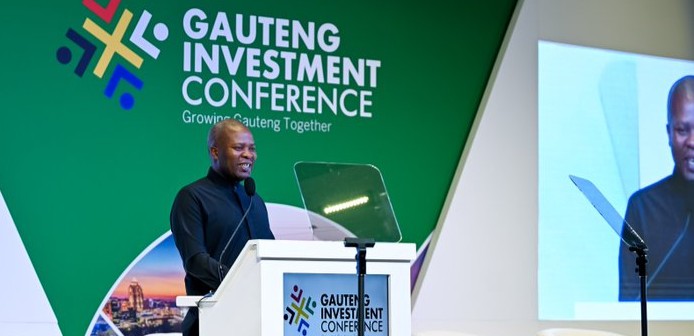
Speaking at the opening of the conference, Maile said Gauteng is shifting from “mobilisation to institutionalisation” of investment, as the province seeks to convert pledges into tangible economic activity.
The conference, now in its second year, has evolved from a traditional investment showcase into what Maile described as a “central instrument” for driving growth, coordinating stakeholders, and translating policy into implementation.
From pledges to projects
The inaugural 2025 conference attracted more than 1 800 participants and secured R312.5-billion in investment pledges, signalling renewed investor confidence in South Africa’s economic hub. However, Maile stressed that success is no longer measured by headline figures alone.
“Investment conferences are not judged by what is announced, but by what is delivered,” he said.
According to Maile, a “meaningful portion” of those commitments has already moved into implementation, unlocking tens of billions of rand into infrastructure, industrial capacity, energy systems, and job creation.
This progress, he argued, reflects a deliberate shift to a lifecycle-based investment model – one that spans project origination, preparation, packaging, investor engagement, facilitation, delivery, and aftercare.
A multiplier for growth
Maile described the Gauteng Investment Conference as a “force multiplier” that integrates project preparation, intergovernmental coordination and capital mobilisation into a single system aligned with the Gauteng Economic Plan.
The province, which contributes roughly a third of South Africa’s GDP, remains the country’s primary economic engine and a key gateway into African markets. Yet it faces structural constraints, including low national investment levels, infrastructure backlogs, and energy instability.
At the same time, intensifying global competition for capital and shifting supply chains are reshaping investor expectations.
“Investors are no longer responding to ambition alone,” Maile said. “They are responding to credibility, governance, execution capability, and the ability to convert opportunity into outcomes.”
Focus on high-growth sectors
The 2026 conference is structured around transactions rather than presentations, with curated deal rooms and sector-focused engagements aimed at accelerating project closure.
Priority sectors include:
- Advanced manufacturing
- Logistics and transport infrastructure
- Digital infrastructure
- Renewable energy and green hydrogen
- Agro-processing
- The creative economy
Maile said the province is strengthening coordination across national, provincial, and municipal pipelines to present “one government” to investors, reducing fragmentation and improving project visibility.
Continental ambitions
A key feature of this year’s conference is the Gauteng Pan-African Economic Partnership Mobilisation initiative, which seeks to align with the African Continental Free Trade Area and the African Union’s Agenda 2063.
The aim is to build cross-border value chains and position Gauteng as a gateway to Africa’s industrialisation.
Maile argued that if successful, Gauteng’s model could serve as a blueprint for other African regions seeking to compete globally through integrated, investment-ready ecosystems.
Aftercare and execution in focus
A major emphasis for the 2026 Gauteng Investment Conference is post-conference implementation. Maile highlighted the importance of “aftercare” in ensuring that projects progress efficiently through regulatory approvals, financing, and construction.
He called on municipalities to accelerate approvals and align project pipelines, while urging development finance institutions and banks to expand blended finance solutions that can de-risk large-scale infrastructure investments.
The private sector, he added, should view itself not merely as participants but as co-investors in the province’s growth trajectory.
From promise to performance
Framing the conference under the theme Re-Industrialising Africa’s Gateway: Investment, Innovation and Integrated Growth, Maile said Gauteng is building a system for continuous capital formation rather than relying on one-off events.
“We are not presenting a wish list,” he told delegates. “We are presenting structured opportunity – bankable projects, aligned policy frameworks, coordinated institutions, and an administration committed to delivery.”
With project pipelines prepared and partnerships taking shape, Maile concluded that the province is ready to move “from promise to performance” as it seeks to entrench investment-led growth in South Africa’s economic heartland.