
17 July 2026
By Mandla Mpangase
South Africa’s Special Economic Zones (SEZs) are expected to play an increasingly important role in driving industrialisation, investment and export-led growth, with the Tshwane Automotive Special Economic Zone (TASEZ) well-positioned as one of the country’s leading examples of what a modern, high-performing SEZ can achieve.
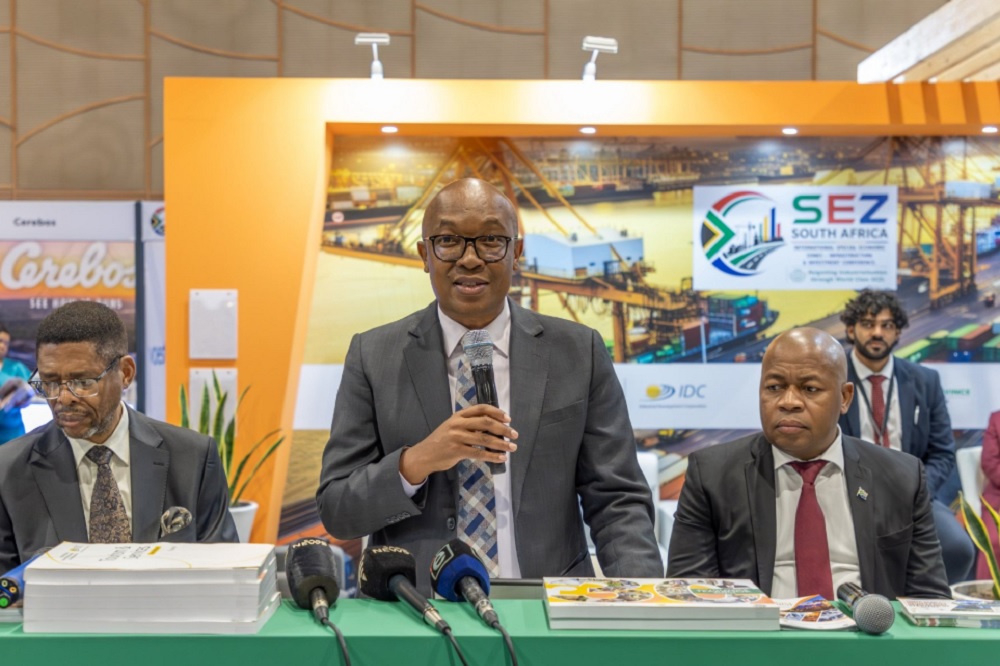
Opening the exhibition component of the 2nd International Special Economic Zones Infrastructure and Investment Conference in Durban on Thursday, Minister of Trade, Industry and Competition, Parks Tau, said the country’s network of SEZs has become a significant contributor to industrial development and will form a central pillar of the government’s long-term economic strategy.
Addressing more than 1 000 delegates from government, industry, development finance institutions, and international partners, Tau highlighted the scale of South Africa’s SEZ programme, noting that 13 designated SEZs across eight provinces now host 224 companies, which have collectively invested R31.7-billion and created more than 28 000 jobs. The Department of Trade, Industry and Competition (the dtic) has invested approximately R12-billion in bulk and top-structure infrastructure to support the zones.
“The exhibition floor shows policy in practice,” Tau said, encouraging delegates to engage directly with investors, incentive packages, and development opportunities represented by the country’s SEZs.
Among the country’s standout performers is TASEZ, which has rapidly established itself as one of South Africa’s flagship industrial zones. Situated adjacent to Ford Motor Company’s Silverton Assembly Plant in the City of Tshwane, the automotive-focused SEZ has become a benchmark for integrated industrial development, attracting major investment, strengthening local supplier networks, and supporting South Africa’s automotive manufacturing ambitions.
The minister cited the expansion of another successful automotive-focused zone, the uMlathuze TradePort Special Economic Zone, as evidence that targeted infrastructure investment can unlock substantial private-sector participation. He noted that the expansion had attracted R16-billion in private investment, alongside billions more from public investors, and created more than 3 300 direct jobs.
For TASEZ, these outcomes reinforce the value of the automotive SEZ model. The zone has already become a critical component of South Africa’s automotive value chain by enabling supplier localisation, supporting component manufacturers, and strengthening export competitiveness around one of the country’s largest vehicle assembly plants.
Tau also announced that the government will use the conference to table an independent World Bank review of South Africa’s SEZ programme. The findings will inform a revised implementation model aimed at encouraging greater private-sector participation, strengthening financial and non-financial incentives, and introducing mechanisms to improve the performance of underperforming zones.
Responding to questions from the media, Tau confirmed that the government had accepted many of the World Bank’s recommendations and was aligning them with its broader industrial strategy.
“We see SEZs as a critical part of the industrialisation pathway for South Africa,” he said.
Rather than setting arbitrary investment targets, Tau said the government wants SEZs to become catalysts for broader economic development, generating opportunities throughout supply chains and creating value beyond the zones’ boundaries.
“It is about the supply chains, the suppliers that come into the industries in the SEZs. It is about value chains that are created,” Tau said.
That vision closely aligns with TASEZ’s development model.
The Tshwane-based SEZ has consistently focused on expanding local procurement, developing small and medium-sized enterprises, investing in workforce skills, and creating an automotive ecosystem capable of competing internationally. As South Africa prepares for the transition towards new energy vehicles and deeper participation in the African Continental Free Trade Area (AfCFTA), TASEZ is increasingly positioned to support regional manufacturing and export growth.
Throughout the two-day conference, delegates are expected to discuss strengthening SEZ infrastructure, financing industrial development, expanding regional value chains, and unlocking export opportunities through the AfCFTA. The programme also includes export masterclasses, investor discussions, the inaugural SEZ Achievement Awards, and the presentation of new investment commitments and partnership agreements.
For TASEZ, the conference represents more than an opportunity to showcase its achievements. It offers a platform to demonstrate how a strategically planned automotive SEZ can accelerate industrialisation, attract investment, and build resilient manufacturing value chains, precisely the role government envisages for South Africa’s next generation of economic development.